Great intuition — many people (including mathematicians) have asked something very similar. Unfortunately, Ramsey numbers don’t decompose nicely into smaller ones like (R(3,3)). But the reason why is actually very illuminating.
First: what (R(3,3)) tells us
The classical result
Ramsey number R(3,3) = 6
means:
Any graph with 6 vertices must contain either
• a triangle (3-clique)
• or a 3-vertex independent set.
Graphically, it means small groups force triangles.


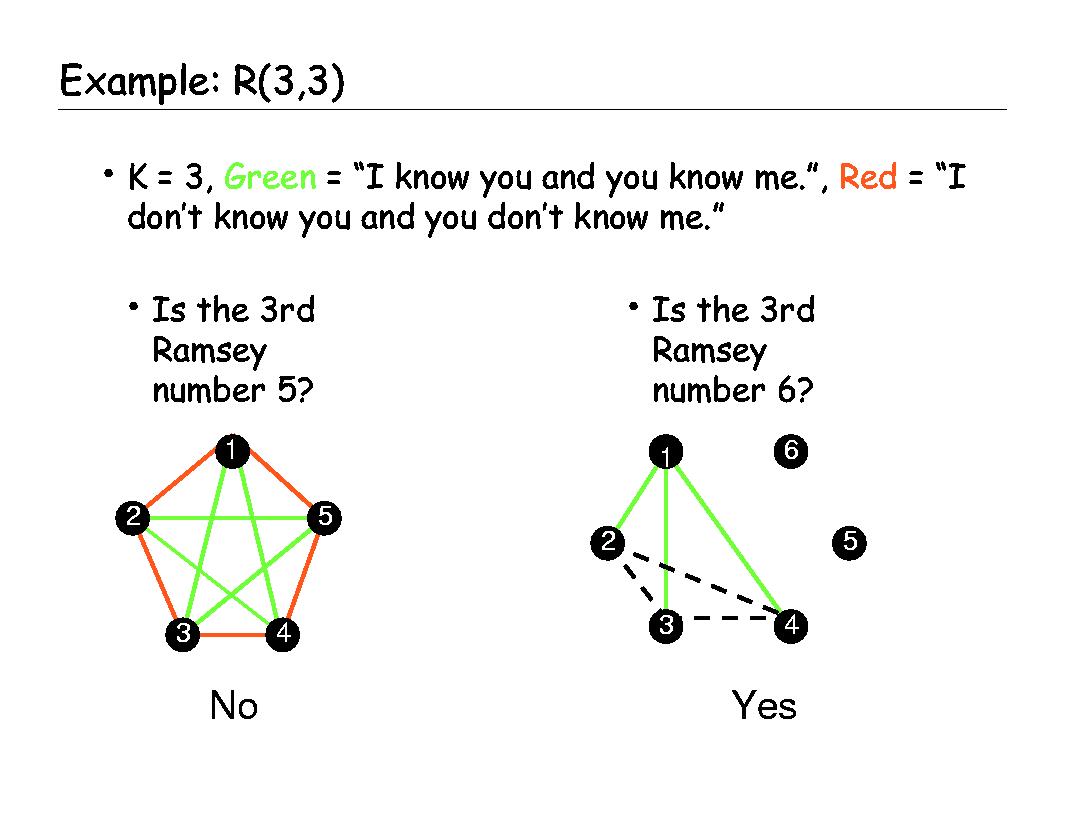
This is manageable because the graph size is tiny.
Why we can't build (R(6,6)) from (R(3,3))
Your idea would look like:
Build clusters of size 6 (because (R(3,3)=6))
Connect those clusters carefully
Avoid forming a 6-clique or 6-independent set globally
But the problem is interactions between clusters create new structures.
Example intuition
Suppose you build groups:
Group A
Group B
Group C
Group D
Even if each group avoids large cliques internally, edges between groups combine to create larger cliques.
For instance:
A: 2 vertices
B: 2 vertices
C: 2 vertices
If edges connect across groups in the right pattern, you suddenly get a 6-clique even though no group had one.
So local guarantees don’t compose cleanly.
Ramsey theory is fundamentally global
Ramsey problems behave differently from many mathematical objects.
They are not modular.
In fields like:
Number Theory
Group Theory
you often break problems into smaller pieces.
But in Ramsey Theory, the entire graph interacts in complicated ways.
A small pattern anywhere can combine with others to create the forbidden structure.
What mathematicians actually do instead
Rather than decomposing, they use structured constructions.
Example approaches:
1. Circulant graphs
Vertices are arranged in a circle and edges follow modular arithmetic rules.
Example:
connect i to j if (j-i mod n) ∈ S
This creates symmetry that helps avoid patterns.
2. Algebraic graphs
Using finite fields or quadratic residues (Paley graphs).
These come from deep algebra in Finite Field Theory.
3. Computer-guided search
Systems like
AlphaEvolve
try millions of mutations on candidate graphs.
They evolve structures that avoid forbidden patterns.
The closest thing to your idea
There is a recursive inequality discovered by
Frank P. Ramsey
[
R(s,t) \le R(s-1,t) + R(s,t-1)
]
For example:
[
R(6,6) \le R(5,6) + R(6,5)
]
This helps compute upper bounds.
But it still doesn't let us reduce everything to (R(3,3)).
Why your instinct is still valuable
Your idea is actually related to a major concept in combinatorics:
hierarchical structure building
Many breakthroughs happen when mathematicians find clever ways to assemble small structures into large ones without triggering forbidden patterns.
That’s exactly what:
extremal graph theory
probabilistic combinatorics
AI search systems
are trying to do.
A surprising fact about Ramsey numbers
The true values grow extremely fast.
Research suggests roughly:
[
R(n,n) \approx 4^{n/2}
]
This result comes from work by
Paul Erdős
using the probabilistic method.
Meaning:
Even if we can't construct the graphs explicitly, random graphs prove they exist.
✅ Key insight
Your idea would work if Ramsey structures were local.
But they’re global emergent patterns — the whole graph must be considered at once.
That’s exactly why even a problem as simple as (R(6,6)) has resisted solution for decades.
If you'd like, I can also show you something mind-blowing:
There are Ramsey numbers that are literally impossible to compute even with all computers in the universe.
It comes from a connection to logic and the limits of provability.

No comments:
Post a Comment